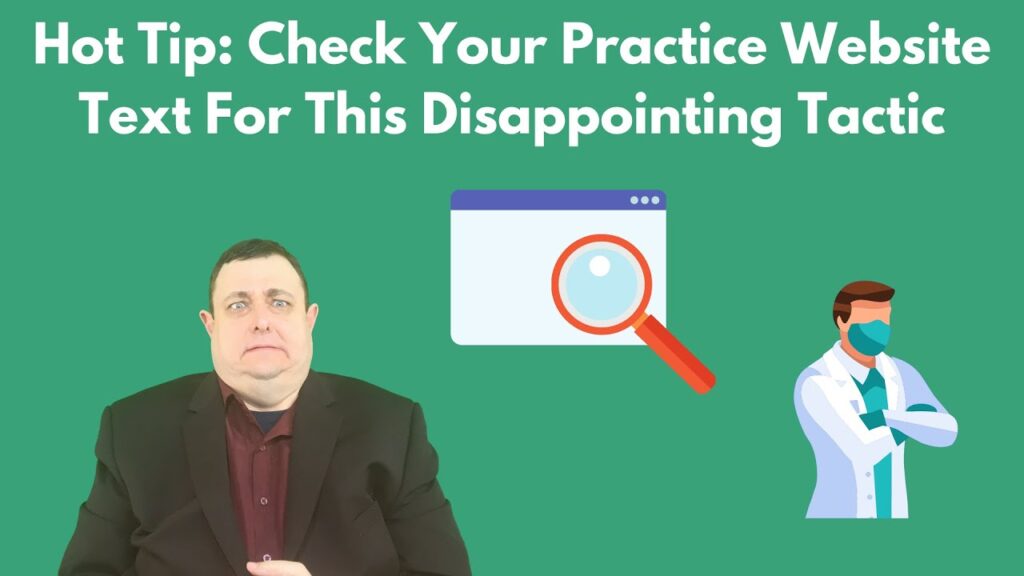
You may have looked at your ads and landing pages on your laptop and think they look good. They represent you well.
However, there’s a very high likelihood that what your new patients are seeing is something different. It could even be embarrassingly bad.
In this video, I’ll tell you what’s probably going on and how you can fix it.
P.S. If you want to know the marketing methods million dollar practices use, watch my new webinar “How I Added $100K+ Per Month To A Practice’s Revenue Using Simple Social Media Ads” Click Here
The data proves it. If you’re sending paid clickers from your new patient marketing directly to your website you are losing 41% or more of the results.
Wowza!
Why? Your website’s gorgeous and represents you well. How could this be true?
It’s because people are people.
The way to fix it is with a properly formatted and disciplined landing page.
It used to be quite the game to get as many “likes” as possible for your Facebook business page.
People put up posters in their practices and sent out emails.
But things have changed a lot since then. Having tons of “Likes” now can be a liability.
For example, Facebook will let your competitors target people, in part, because they “Like” your fan page. What?!? Yep. So what should you be doing instead?
How can you turn this liability into something positive?
Where is the Best Place on Facebook to Publish Your Ads?
There are a lot of options when it comes to running your ads on Facebook as to where to place them and Facebook doesn’t make it easy for you to understand what each of those options actually are.
Newsfeed, Sidebar, Audience Network, In-app placements, Facebook Stories, Instagram Stories, Instagram Feed, In-Stream, Reels Overlay, Search, Messenger, In-Article… the list goes on and on. There must be about 15 different placements where your ad can appear.
By default, Facebook enables them all for you automatically but the problem is when it comes to new patient marketing 90% of those placements will do nothing more than spend your money and get you low results. I know, because I’ve tested every single one of them!
In doing so, I found that only a couple of placements actually work for attracting new patients. The rest just leak money away from your budget into a black hole that apparently leads to Mark Zuckerberg’s back pocket. If you were selling a product rather than a service some of these other options might work better, but for new patient marketing, it’s down to two placements and only one placement if you aren’t re-marketing to people who already know you. The Facebook News Feed.
Why Where People See Your Ads is Important
You have to take the point of view of the person viewing the ad. Facebook is a social media platform that people browse in their spare time. For example when they are on their lunch break, when they get home from work, or when they are lying in bed and can’t sleep. This is perfect for getting a new message across because their attention is on finding something to read that may interest them.
Ad placements such as the “In-App” or “Messenger” options are advertisements that show up when a person is playing a game like Angry Birds or when they are chatting with friends on Facebook. They have to stop what they are doing to view these types of ads and very few people click on a knee pain ad when there attention is elsewhere.
You want to show the ad where it is most likely to attract attention. Almost every other ad placement option is put in front of the person while they are engaged in an activity. The news feed is not.
There are many other factors that go into creating an ad that generates a consistent flow of qualified new patients, such as targeting, headlines, images and the of course your offer, but knowing where to place your ads for the best result is a first great step. To learn how to get the most out of your ads, I invite you to download and read my e-book Chiropractors: 16 Rules for Facebook Marketing Success.
How Fixing This Common Marketing Mistake Can Improve Your Results
One of the big rookie mistakes I made early on in Facebook marketing was trying to tell patients how awesome the doctor was, how cool the new laser was, or trying to convince them how we were different than everyone else.
Every time we talked about the new decompression machine, or the new Class IV laser the office used, people ignored my ads like they were written in a foreign language.
It took me time to figure out why this was but when I finally cracked it, it was not only enlightening but it opened the door to a whole new way of running ads. Ads that consistently drove in new patients mind you.
What Was The Solution?
The key was using what was real to the patients in our ads. I found this out by talking to the patients in the office and discovered they were not impressed by the machine not one bit. They just wanted to know if we could help them with the pain. What was real to them was the pain.
So instead of writing ads about the modalities we offered, we wrote ads that used the words that they used. “Bone-on-Bone Knee Pain”, “Stiffness in the Knees”, “Unable to Play with My Grandkids”, and wouldn’t you know it people started responding to the ads in droves. We call it, “Painting the Pain.”
It’s all about how you communicate and how you can reach the person on the other end of the ad. If you’re going to connect with new patients, you have to speak their language. They only care about one thing, and if you speak to that one thing, you’ll have their attention.
I cover this in my e-book Chiropractors: 16 Rules for Facebook Marketing Success along with 15 other key points that have proven successful in attracting a consistent flow of qualified new patients. In it you can find the answers on how to adjust your ads to enable the best results for you and your practice.
It’s free and its my way of helping docs use Facebook to market their practices and help people find the care they need.
Once I Realized The Truth, It changed Everything About How I Used Facebook
Contrary to popular belief doc, Facebook is not a social media platform.
It used to be, in its early days, when you created a post on Facebook, and maybe 800 people saw your post. It would push it out to the masses and anyone its algorithms thought would benefit from reading what you wrote. Now it’s completely different.
You’d be lucky to have 8 people see your posts and there is a fundamental reason why. Facebook is at its heart, a marketing platform. It uses its social media aspect of it to attract people together and collect data so that advertisers can specifically target those people for products and services.
It may have been a social media platform when it started but once they realized people would pay to communicate specifically to certain groups of people it shifted.
But what does this mean for your practice?
Well, first if you are using Facebook as a social media platform and hoping to get new patients you’re going about it all wrong. You have to look at Facebook as paid advertising platform if you really want to get in front of people and attract qualified new patients for care.
It takes time to learn the ins and outs of Facebook marketing for your practice. But that is why I took all the information I’ve learned to attract qualified new patients for my clients and wrote down all the key points you will need to run a successful Facebook new patient marketing campaign.
In my e-book, Chiropractors: 16 Rules for Facebook Marketing Success, you will learn the exact points that I have found that create successful new patient marketing campaigns on Facebook.
It’s free and its my way of helping docs learn how to use Facebook to market their practice.
A lot of chiropractic consultants are all sizzle and no steak. Clinic Masters brings something refreshingly practical to the table.
Some doctors who see 30, 50+ patients a day get physically worn out. This is not sustainable. Doctors who are committed to their practices, but at the expense of their health and family life. This, too, is not workable. Doctors who have wanted to get into a particular niche but don’t know where to start.
Dr. Matt and Dr. Rob did an exclusive interview with Million Dollar Practice Builders covering all of the above points and more, providing practical solutions to the problems so many practice owners run into.